One lag doesn't fit all markets: look-ahead in US and Korean fundamentals
I checked when 356,323 company reports from the US and Korea became public, and compared that with the dates backtests usually assume. Lags of 40 days for quarterly and 60 days for annual reports, the deadlines for large US companies, use 99% of Korean reports too early. Used on the day itself, even Korea's own deadline takes about half of its quarterly reports a day early, because most of them land after the market closes.
One report, four backtests
Samsung Electronics filed its report for the quarter to 31 March 2025 on 15 May 2025. A backtest that joins fundamentals at the period end used it 45 days before that.
| Backtest setup | First uses the report | Before the filing |
|---|---|---|
| Join at the period end | 31 Mar 2025 | 45 days |
| US large-company lag, 40 days | 12 May 2025 | 3 days |
| Fixed lag, 45 days | 15 May 2025 | same day |
| Filing date, then the next trading day | 16 May 2025 | no, a day after |
The 45-day row looks fine but probably isn't. 15 May was the deadline, and 70% of the KOSPI quarterly reports filed that day came after the 15:30 close. OpenDART gives only the date, so the backtest can't tell.
Samsung isn't unusual. Three in four Korean companies filed that quarter's report on the last allowed day. I wanted to know how big this is across a whole market, so I measured it for every US 10-Q and 10-K and every Korean periodic report from 2015 to 2025.
Data and method
Both sources are free and public, and all the code is on GitHub: github.com/pawit121/pit-lag.
- US: the SEC's Financial Statement Data Sets, 2015 Q1 to 2026 Q3. I kept the first 10-Q or 10-K for each company and period: 266,086 filings with period ends in 2015–2025, each with the time EDGAR accepted it.
- Korea: OpenDART's disclosure list, through its English API, for KOSPI and KOSDAQ companies. That gave 90,237 quarterly, half-year and annual reports for the same periods, each with the date it was received.
For every report I set a first usable day: the first day a backtest that trades on the close could have known it. In the US that's the acceptance day if EDGAR accepted the filing before 16:00 New York time, otherwise the next business day. OpenDART has no times, so for Korea it's the next business day after the filing date.
To see how much the missing time matters, I counted filings on KRX's KIND site, which does show times. On five deadline days from 2019 to 2025, 6,158 of 9,294 reports (66%) arrived at or after the 15:30 close. Where this decides the answer, the Korean numbers below are estimates that use that 66%.
A lag of k days attaches a report on the period end plus k days, moved to the next business day if needed. It uses the report too early when that date comes before the first usable day.
How long companies take to file
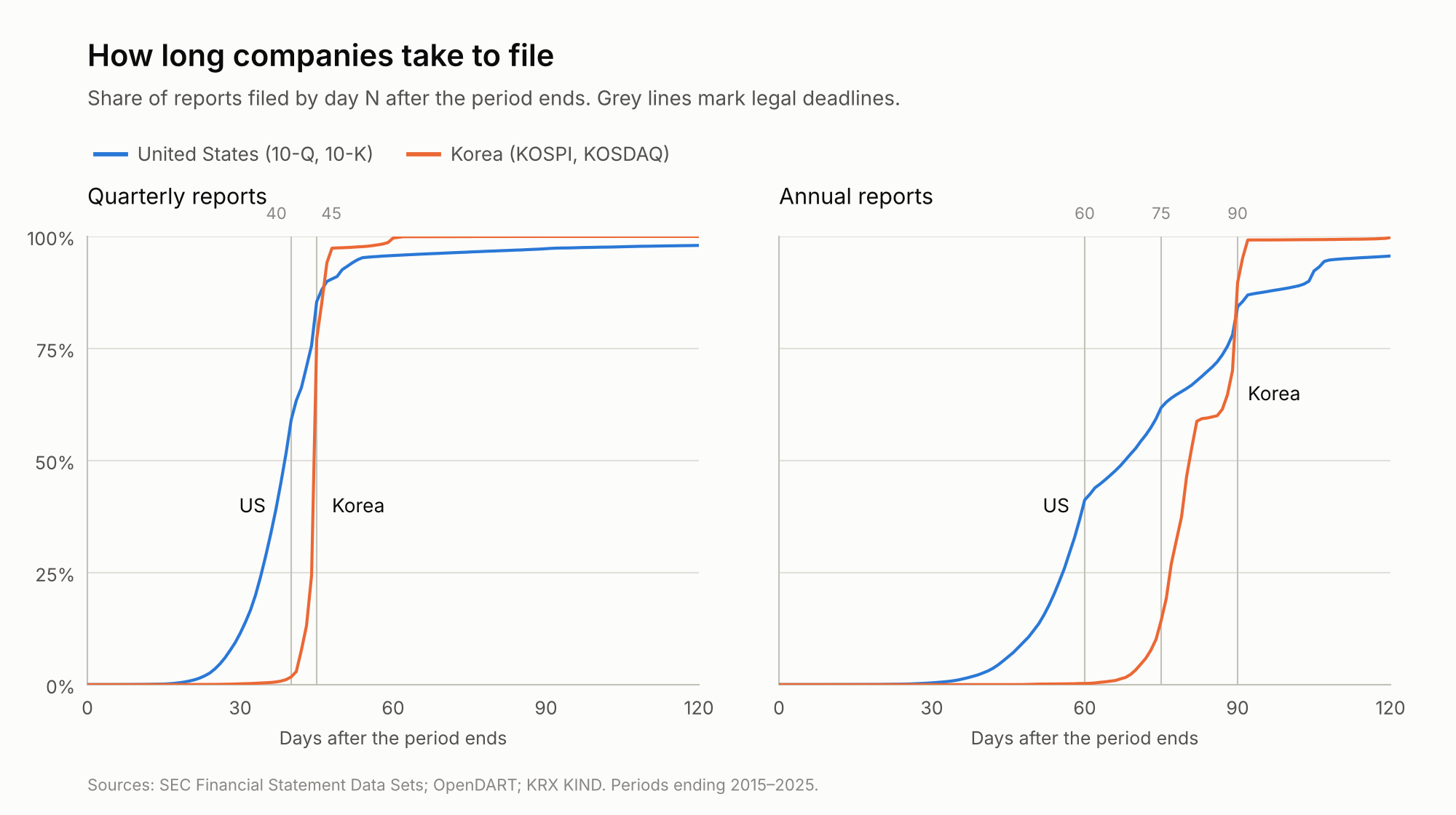
US companies spread out before their deadline, and size decides how early. On median, large companies file a 10-Q in 34 days against a 40-day deadline, and a 10-K in 55 against 60. The smallest take 44 of their 45 days, and 88 of their 90.
Korean companies wait for the deadline. Quarterly and half-year reports are due in 45 days, and the median is 45. Annual reports were the same until fiscal 2019, mostly filed on day 90. From fiscal 2020 the median moved to 77–80 days.
What each lag uses too early
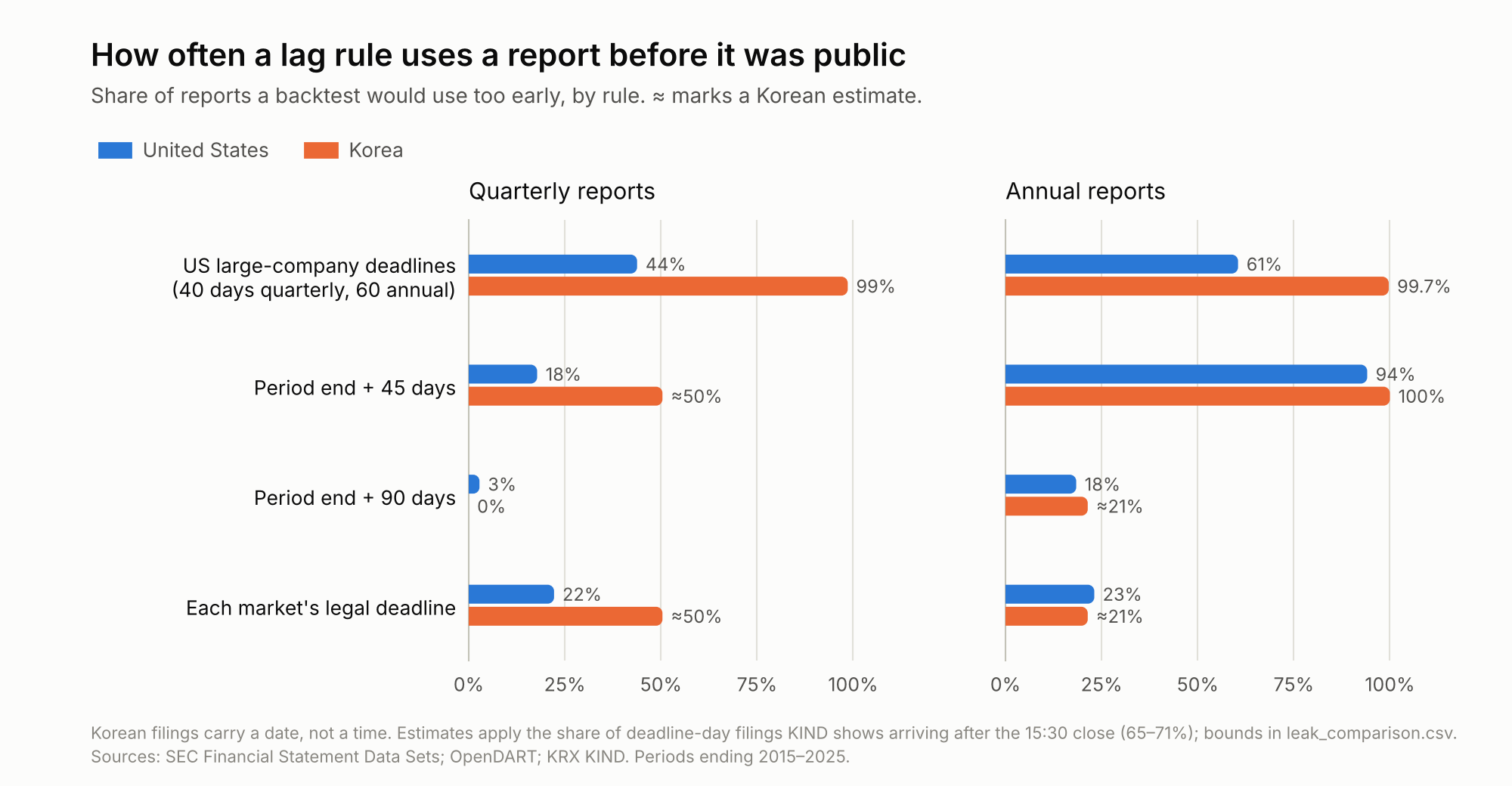
The US lags are fine for large US companies, but in Korea they use almost every report too early: a median of 6 days early for quarterly reports and 21 for annual ones. A fixed 45-day lag looks safer. It isn't, because Korea files on day 45 and mostly after the close.
A 90-day lag is safe for Korean quarterly reports, but it throws away about six weeks of data that was already public. And a market's own deadline only works if you move to the next trading day. Used on the deadline day itself, it catches everyone who files on the last day after the close, plus the late filers.
The fix
Use the filing date when you have it, and the legal deadline when you don't, then move to the next trading day. The last step matters more than it looks, because in both markets most deadline-day filings come after the close.
Done this way, the deadline fallback uses 5.2% of US filings and 2.3% of Korean reports too early, against 22% of US filings and about half of Korean quarterly reports when the deadline day itself is used. What's left is late filers, mostly small US companies. The US figure counts the extension a late filer can claim with Form 12b-25 (15 days for a 10-K, 5 for a 10-Q); without it, 12% are early.
I put this in a small Python helper, pit_lag: one file, MIT licence. It has the deadlines for the US, Korea, Hong Kong, China and Thailand, including the dates they changed, and works on any data that has period ends.
import pit_lag

pit_lag.available_date("2025-03-31", "KR", "quarterly")
# Timestamp('2025-05-16 00:00:00')

# Filing dates where you have them, deadlines where you don't
fund["available"] = pit_lag.available_date(
    fund["period_end"], fund["market"], fund["report_type"],
    filer_class=fund["filer_class"], filed=fund["filed"])

# Check a backtest you already have
pit_lag.audit(panel, used="date", market="KR", report_type="quarterly")
audit() prints how many rows were used before their report was public. On the data in this post, the helper gives the same first usable day as my US analysis for all 266,086 filings.
What this doesn't claim
- Earnings releases come first. Most large companies announce headline numbers before the periodic report: an 8-K in the US, a preliminary earnings disclosure in Korea. The filing date is the conservative date, the one by which every line item is public. If you only use headline numbers you can go earlier, but you need the release dates for that.
- Nothing about returns. I measured when data became public, not how much the leak changes a backtest's results. That depends on the strategy.
- First filings only. Amendments are a separate problem: 3.5% of 10-Ks were amended later, and 23% of Korean annual reports were corrected, though mostly in the text.
- The Korean timing comes from a sample. The 66% is from five deadline days, not every filing. It was steady from 2019 to 2025, but the Korean estimates carry that uncertainty, so they're marked ≈ in the chart.
- US period ends are rounded. The SEC data rounds them to month-end, which moves 52/53-week filers by a few days.
Prior work
- S&P Capital IQ's Point-In-Time vs. Lagged Fundamentals (2015) tested 2- and 3-month lags against point-in-time data in the US, Europe, Japan and emerging markets. The lags didn't reproduce the point-in-time results; in Europe they overstated returns in 40 of 48 tests. That paper looks at returns. This post looks at the dates underneath.
- Tradevo Data's Your backtest saw the future (2026) measured the gap between period end and filing date for US companies. US only.
- AlgoLab's guide to OpenDART financial data (24 Sep 2026, in Korean) explains the problem for Korea and recommends the filing date plus one trading day, the same fix as here. It doesn't measure it or compare markets.
- edgartools has an
as_ofparameter for trailing-twelve-month figures. A maintainer noted on 27 Oct 2026 that it limits period ends, not filing dates, and a filing-date cutoff is still being designed (issue #1699).